
# 1121 Basmati Rice: Complete Guide for International Rice Importers
**Meta Description:** Learn everything international rice importers need to know about 1121 Basmati Rice, including specifications, varieties, pricing factors, packaging, quality, sourcing, and export considerations.
**Primary Keyword:** 1121 Basmati Rice
**Secondary Keywords:** 1121 Basmati Rice exporter, 1121 Basmati Rice supplier, 1121 Basmati Rice wholesale, Indian 1121 Basmati Rice, 1121 Golden Sella Basmati Rice, 1121 Steam Basmati Rice, 1121 Basmati Rice importer, Basmati Rice supplier from India, Indian Basmati Rice exporter, buy 1121 Basmati Rice, 1121 Basmati Rice price, long grain Basmati Rice, private label Basmati Rice.
## Introduction
For international rice importers, choosing the right Basmati variety is an important business decision. Product quality, grain appearance, cooking performance, consumer preferences, packaging requirements, and overall landed cost can all influence the success of a rice brand in a particular market.
Among the different varieties available from India, **1121 Basmati Rice** has become one of the most recognized choices for international buyers looking for exceptionally long, aromatic rice with attractive cooking characteristics.
The variety is particularly popular in Middle Eastern, Asian, European, African, and other international markets where consumers value long grains, aroma, appearance, and consistent cooking quality.
However, buying 1121 Basmati Rice is not simply about finding the lowest price. Importers need to understand specifications, processing types, quality parameters, packaging, documentation, supplier reliability, and the difference between various 1121 products.
This guide explains the key factors international rice importers should consider before sourcing 1121 Basmati Rice from India.
## What Is 1121 Basmati Rice?
1121 Basmati Rice is a long-grain Basmati rice variety known for its exceptionally long grain length, aromatic characteristics, and ability to elongate during cooking.
The raw rice grain is already visually impressive, but one of its most important characteristics is its cooking expansion. Properly processed and cooked 1121 Basmati Rice can become significantly longer while maintaining a separate, fluffy texture.
This makes it attractive for dishes where presentation is important, including biryani, pulao, kabsa, mandi, and other rice-based dishes.
For importers, however, it is important to remember that **1121 is not a single finished product**. It can be supplied in different processing forms, including:
– 1121 White Basmati Rice
– 1121 Steam Basmati Rice
– 1121 Golden Sella Basmati Rice
– 1121 Creamy Sella Basmati Rice
Each type has different characteristics and may be better suited to particular customers and markets.
## Why Is 1121 Basmati Rice Popular Among International Importers?
Several characteristics make 1121 Basmati Rice commercially attractive.
### 1. Extra-long grain appearance
One of the biggest advantages is the visual appearance of the grain. Long, slender grains create a premium presentation after cooking. This is particularly important for restaurants, caterers, wholesalers, and retail brands selling premium rice.
### 2. Aroma
Authentic Basmati rice is valued for its distinctive natural aroma. Aroma can significantly influence consumer perception and the overall eating experience.
### 3. Cooking expansion
1121 Basmati Rice is known for its ability to elongate during cooking. When properly processed and prepared, the grain can become considerably longer while remaining relatively separate.
### 4. Versatility
The rice can be used for a wide range of dishes, from traditional South Asian biryani and pulao to Middle Eastern rice dishes.
### 5. Strong international demand
The combination of grain length, appearance, aroma, and cooking performance has helped make 1121 Basmati an important product for international rice markets.
## 1121 Basmati Rice Varieties for Importers
Before placing an order, importers should determine which processing type best matches their target market.
### 1121 White Basmati Rice
White Basmati Rice is milled rice with its husk and bran removed. It has a natural white or creamy appearance and is commonly used in households, restaurants, catering businesses, and retail markets.
### 1121 Steam Basmati Rice
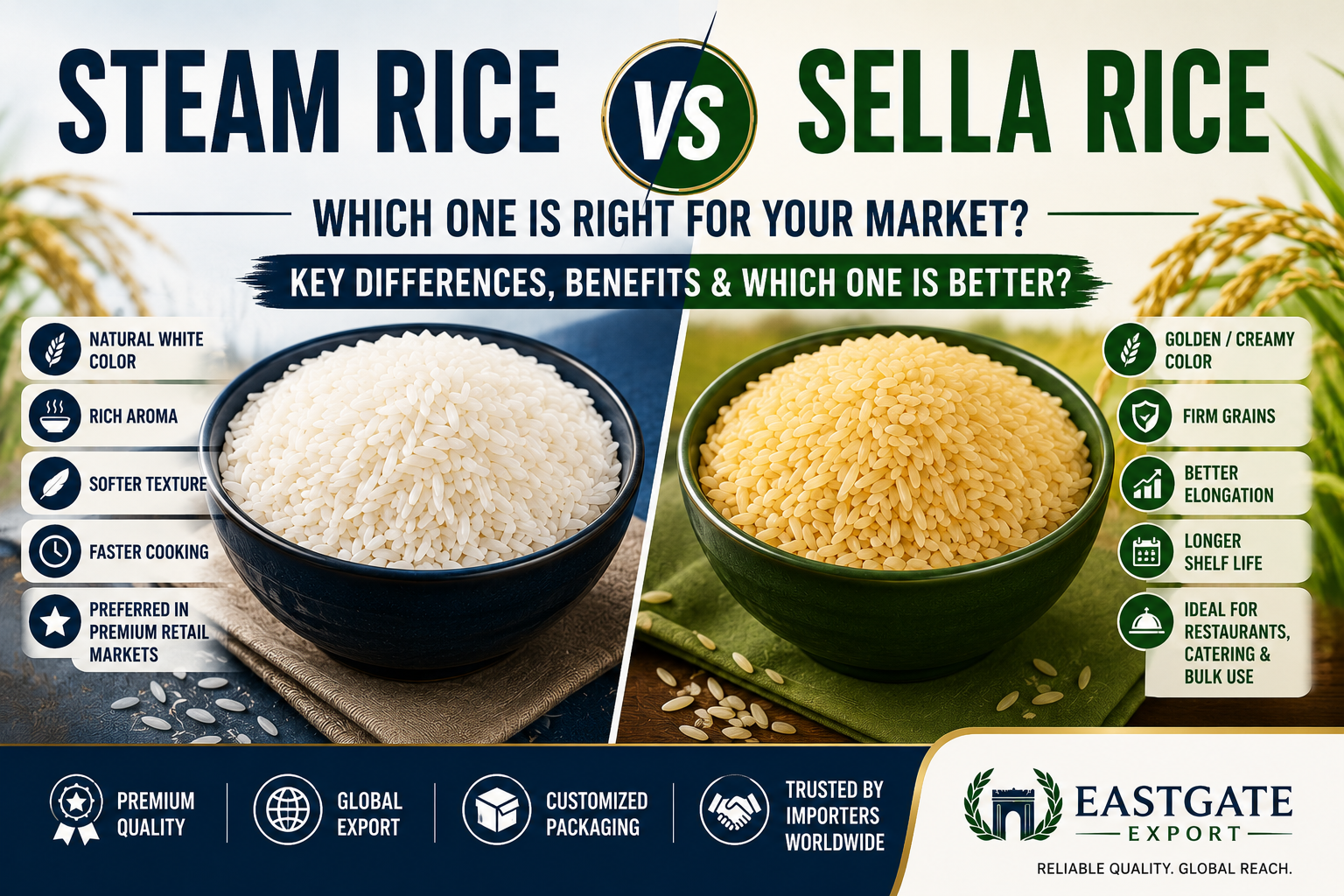
Steam processing involves treating the paddy with steam before milling. The process can help improve certain cooking and handling characteristics while producing a rice grain with a natural appearance. Steam Basmati is widely used by customers looking for long, aromatic rice with good cooking performance.
### 1121 Golden Sella Basmati Rice
Golden Sella is parboiled Basmati rice that generally has a distinctive golden or yellowish appearance. It is especially popular in markets where consumers and food-service businesses prefer rice that performs well in dishes such as biryani and other rice preparations.
### 1121 Creamy Sella Basmati Rice
Creamy Sella has a lighter, creamy appearance compared with Golden Sella. It can be an attractive option for brands looking for a parboiled Basmati product with a different visual presentation.
## Important 1121 Basmati Rice Specifications
International importers should never evaluate rice only by the product name. A professional purchase specification should clearly define the required quality parameters.
Depending on the contract and destination market, buyers may review specifications such as:
– Average grain length
– Moisture
– Broken grains
– Foreign matter
– Damaged or discoloured grains
– Chalky grains
– Admixture
– Sortex quality
– Milling quality
– Aroma
– Cooking characteristics
– Crop year
– Packaging
– Labelling requirements
The exact specification should be agreed between the buyer and exporter before shipment.
### Grain length
Grain length is one of the most important characteristics for 1121 Basmati. Importers should ask suppliers for the exact specification rather than assuming that every product marketed as 1121 has identical physical characteristics.
### Broken percentage
Broken grains can affect both the appearance and commercial value of rice. Premium retail and food-service buyers may require strict broken-grain specifications.
### Moisture
Moisture is another important quality parameter because it can influence storage stability and overall rice quality. The required specification should comply with the buyer’s contract and applicable destination-market requirements.
### Sorting and cleaning
Modern rice processing commonly uses advanced sorting and cleaning systems to remove unwanted material and improve consistency. Importers should discuss the processing and quality-control procedures with the exporter before placing a large order.
## How to Choose a 1121 Basmati Rice Supplier in India
Selecting a reliable supplier is arguably more important than negotiating a small difference in price. International buyers should evaluate several factors.
### 1. Export experience
Ask how long the supplier has been exporting rice and which international markets they serve. Experience with international shipments can be valuable because export transactions involve documentation, logistics, packaging, quality control, and destination requirements.
### 2. Product consistency
A supplier should be able to provide consistent specifications from shipment to shipment. Ask for a clear product specification sheet and, where appropriate, samples before confirming a commercial order.
### 3. Quality control
Understand how the supplier handles cleaning, milling, sorting, grading, inspection, and packaging.
### 4. Packaging capability
If you are building a retail brand, packaging flexibility can be important. Importers may require different formats, including 1 kg, 2 kg, 5 kg, 10 kg, 20 kg, 25 kg, 30 kg, 40 kg, or 50 kg, depending on the destination market, distribution channel, and customer requirements.
### 5. Private-label capability
Many importers do not want to sell rice under the exporter’s brand. Instead, they want to build their own brand. A capable supplier should be able to discuss private-label or customized packaging requirements, subject to applicable regulations and commercial terms.
## 1121 Basmati Rice Pricing: What Importers Should Know
Rice prices can change over time, so importers should be cautious about websites claiming a single permanent price for 1121 Basmati Rice.
The final export price can depend on several factors, including crop and market conditions, processing type, quality specifications, aging, packaging, order quantity, destination, freight, documentation, insurance, port charges, and other logistics costs.
For this reason, importers should request a current quotation based on the exact product specification, quantity, packaging, destination, and shipping terms.
## Bulk and Private-Label 1121 Basmati Rice
For distributors and brand owners, private-label rice can be an attractive business model. Instead of selling an existing supplier brand, an importer can develop its own retail identity and use an Indian manufacturer or exporter as the supply partner.
A private-label project may include:
– Custom rice selection
– Custom packaging
– Brand artwork
– Retail bag sizes
– Product specifications
– Export documentation
– Shipment planning
Before production, the importer should approve packaging artwork and product specifications. It is also important to ensure that labels comply with the regulations of the destination country.
## Packaging Options for International Markets
Packaging plays an important role in both product protection and marketing.
For retail markets, smaller packages such as 1 kg, 2 kg, 5 kg, and 10 kg may be appropriate. Wholesale customers may prefer larger formats such as 20 kg, 25 kg, 30 kg, 40 kg, or 50 kg, depending on market requirements.
Importers should discuss bag material, weight tolerance, printing, product information, barcode, batch information, manufacturing details, country-of-origin information, regulatory labelling, palletization, and container loading with their supplier before production.
## Export Documentation and Compliance
International rice shipments require appropriate commercial and regulatory documentation. The exact requirements depend on the destination country, buyer, product, and shipment terms.
Common export documentation can include commercial invoices, packing lists, certificates of origin, shipping documents, and applicable inspection or health-related certificates. Importers should independently confirm the current requirements with the relevant authorities in their destination market.
A professional exporter should also be able to coordinate the documentation required for the shipment.
## How to Order 1121 Basmati Rice from India
The purchasing process can be straightforward when specifications are clearly defined.
### Step 1: Define your requirements
Decide the rice variety, processing type, quality specification, quantity, packaging, destination, and brand/private-label requirement.
### Step 2: Contact exporters
Request quotations from established Indian suppliers.
### Step 3: Request samples
Where appropriate, evaluate samples before making a large purchase.
### Step 4: Confirm specifications
Agree on the exact specification before production.
### Step 5: Confirm commercial terms
Discuss payment terms, shipping terms, production schedule, and documentation.
### Step 6: Approve packaging
For private-label orders, approve the final artwork and packaging specifications.
### Step 7: Production and quality checks
The supplier prepares the order according to the agreed specifications.
### Step 8: Shipment
Once the shipment is ready and documentation is completed, the cargo can be dispatched according to the agreed logistics terms.
## 1121 Basmati Rice for Restaurants and Food-Service Businesses
1121 Basmati Rice is not limited to retail consumers. Restaurants, hotels, catering companies, and food-service distributors can also benefit from its long-grain appearance and cooking characteristics.
For these customers, important considerations may include consistent cooking performance, grain separation, aroma, expansion, bulk packaging, supply continuity, and competitive commercial pricing.
A restaurant buyer may have very different requirements from a supermarket brand, so exporters should tailor specifications and packaging accordingly.
## Questions International Rice Importers Should Ask Suppliers
Before placing an order, consider asking:
1. What exact 1121 Basmati product are you offering?
2. Is it White, Steam, Golden Sella, or Creamy Sella?
3. What are the agreed grain and quality specifications?
4. What is the broken percentage?
5. What is the moisture specification?
6. What crop year is available?
7. Can you provide a sample?
8. What packaging options are available?
9. Do you provide private-label packaging?
10. What export documentation can you provide?
11. What is the minimum order quantity?
12. What shipping terms are available?
13. Which international markets do you currently supply?
14. How do you maintain consistency between shipments?
A reliable supplier should be able to answer these questions clearly.
## Why Work with an Experienced Indian Rice Exporter?
India has an established rice-processing and export industry with suppliers serving markets around the world. For an international importer, working with an experienced exporter can simplify several parts of the procurement process—from product selection and quality specifications to packaging, documentation, and shipment coordination.
However, buyers should still conduct their own due diligence and verify the supplier, product specifications, certifications, documentation, and commercial terms before entering into a contract.
## Eastgate Export: 1121 Basmati Rice from India
**Eastgate Export Private Limited** supplies Indian Basmati Rice for international B2B markets, including importers, wholesalers, distributors, retailers, restaurants, and private-label businesses.
The company can discuss different Basmati rice requirements, including **1121 Basmati Rice, Golden Sella, Steam and other Basmati varieties**, along with packaging and private-label requirements.
For importers looking to source 1121 Basmati Rice from India, the right starting point is to clearly define your required specifications, quantity, packaging, and destination market.
You can contact Eastgate Export to discuss your sourcing requirements and request a quotation based on your specific needs.
**Eastgate Export Private Limited**
Website: www.eastgateexport.com
Email: info@eastgateexport.com
Phone: +91 80763 53873
## Frequently Asked Questions
### Is 1121 Basmati Rice good for international markets?
Yes. Its long-grain appearance, aroma, cooking expansion, and versatility make it a popular choice for many international markets.
### What is the difference between 1121 Golden Sella and 1121 Steam?
They are different processing categories. Golden Sella is parboiled and generally has a golden appearance, while Steam Basmati has a different processing method and typically retains a more natural rice appearance.
### Can I buy 1121 Basmati Rice in bulk from India?
Yes. International importers can source bulk quantities from Indian rice exporters, subject to supplier minimum order quantities and commercial terms.
### Can I create my own private-label Basmati Rice brand?
Yes, many exporters offer private-label solutions. Packaging, minimum quantities, artwork, labelling, and other requirements should be discussed with the supplier.
### How can I get a quotation for 1121 Basmati Rice?
Provide the exporter with the required rice type, specification, quantity, packaging, destination country, and preferred shipping terms. The supplier can then prepare a quotation based on your requirements.
## Final Thoughts
For international rice importers, **1121 Basmati Rice can be an attractive product because of its distinctive long grain, aroma, cooking performance, and broad market appeal**.
But successful rice sourcing is about more than selecting a variety. Importers should carefully evaluate product specifications, supplier reliability, quality control, packaging, documentation, logistics, and destination-market requirements.
Whether you are a wholesaler importing bulk rice, a distributor supplying restaurants, or a brand owner developing a private-label product, choosing the right Indian supplier is an important part of building a reliable rice business.
If you are looking for **1121 Basmati Rice from India for wholesale, distribution, retail, or private-label purposes**, contact Eastgate Export to discuss your requirements.
**Eastgate Export — Indian Basmati Rice for Global Markets.**